K-Electric Net Billing 2026: Apply, Requirements, Rates and Benefits
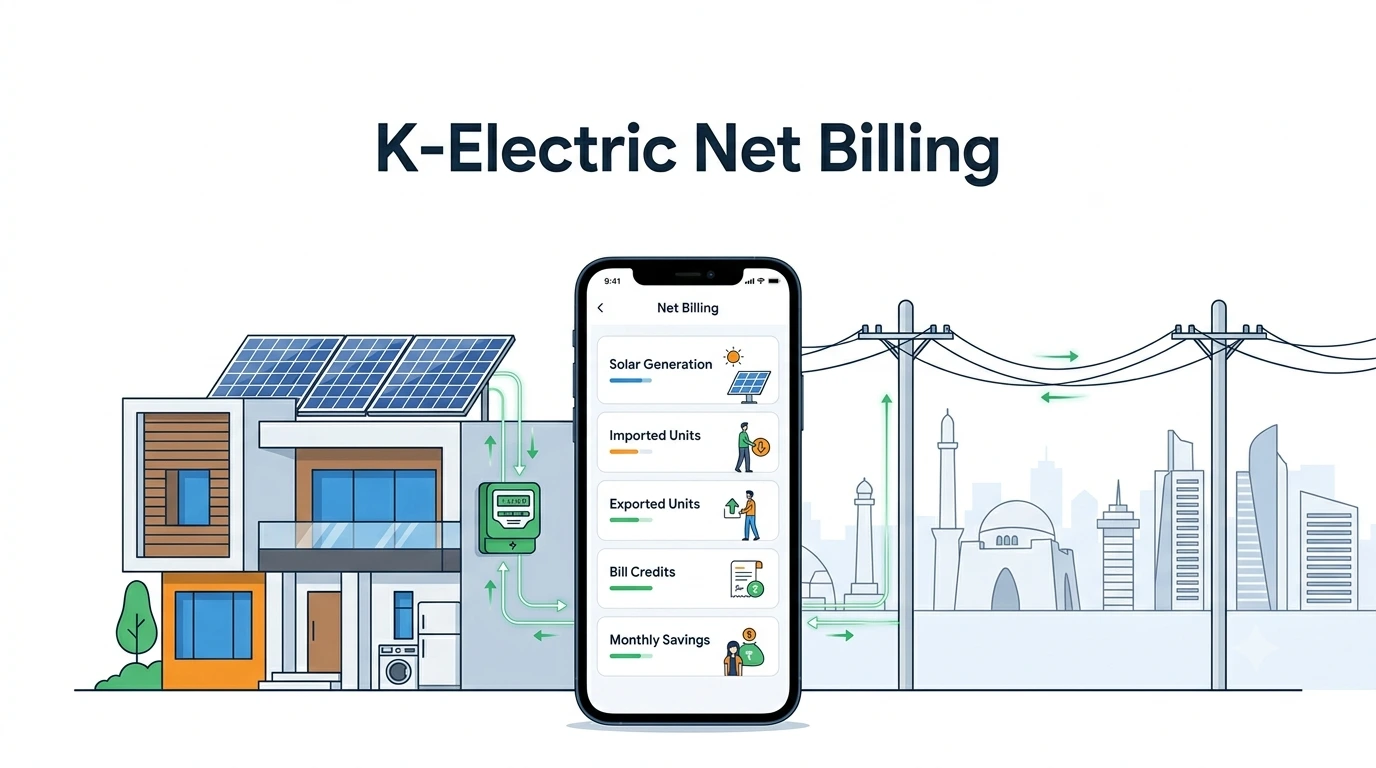
K-Electric net billing is the current system for solar, wind, and biogas owners who export surplus electricity to the grid. NEPRA replaced net metering with net billing in February 2026. If you already have solar, whether this affects you depends on when your agreement was signed.
What Is Net Billing?
Net billing values the electricity you export and import separately, instead of treating them as equal. You sell surplus power to K-Electric at one rate and buy power at a different, higher rate. This replaced the older system, where exported and imported units simply cancelled each other out.
Net Metering vs. Net Billing: What Changed in 2026
| Old Net Metering | New Net Billing | |
|---|---|---|
| Basis | Units exchanged 1 to 1 | Units valued separately in rupees |
| Export rate | Same as your import rate | National Average Energy Purchase Price, reviewed periodically |
| Import rate | Same as export rate | Your standard consumer tariff |
| Regulation | Net Metering Regulations, 2015 | NEPRA Prosumer Regulations, 2026 |
NEPRA notified the Prosumer Regulations on February 9, 2026, formally replacing the 2015 framework. Under the old system, exporting 400 units and importing 400 units left you close to a zero bill. Under net billing, those two numbers are no longer equal in value, since your import rate is meaningfully higher.
Are You Affected? Existing Agreements vs. New Applications
This is the most important question if you already have solar installed.
If you had a valid net metering agreement as of February 9, 2026, you generally continue under those terms. This lasts until the agreement expires. NEPRA confirmed this after industry pushback. A large batch of pre-February 8 applications, representing hundreds of megawatts, were also processed under the old rules. Confirm your agreement status with K-Electric.
If you are applying for the first time now, your application falls under the new net billing framework. This includes the lower export rate and the updated terms described below. Confirm your own agreement’s status directly with K-Electric, since exact cutoff handling can vary by case.
If you keep your old net metering agreement, be careful modifying your system later. Changes to an existing system may be treated as a material modification and could affect your applicable agreement terms. Confirm with K-Electric before expanding a system covered by an existing net metering agreement.
How Does K-Electric Net Billing Work?
Under net billing, K-Electric buys your exported electricity based on the applicable National Average Energy Purchase Price. This can change when NEPRA revises it, so check the latest notification before calculating your expected savings. Electricity you import continues to be billed at your standard residential tariff. For current tariff rates by consumption slab, see our K-Electric per unit price guide.
Your net payable amount is your imported units at the retail rate, minus your exported units at the buyback rate. Since the retail rate is significantly higher, exporting large volumes is no longer the most valuable strategy. Using more of your own solar generation directly now matters more for savings. Check your net payable amount on your KE bill each month. Pay through our K-Electric bill payment guide.
K-Electric Net Billing Example
Here is how the concept works with a simple example. Suppose your solar system generates 500 units in a month. You use 350 units directly in your home, while the remaining 150 units are exported to the grid. Separately, you import 200 units from K-Electric during hours your system isn’t producing enough.
Under net billing, those two flows are valued separately, not cancelled against each other. Your 150 exported units are credited at the applicable buyback rate. Your 200 imported units are charged at your applicable consumer tariff. Because the import rate is higher than the buyback rate, your bill reflects that difference rather than netting to zero.
What Is a Bi-Directional (Green) Meter?
A bi-directional meter measures electricity flowing both ways. It tracks power from the grid and power going out from your solar system. NEPRA requires these meters to meet specific accuracy and safety standards. Two separate meters can be used instead, but their combined readings must match a single bi-directional meter.
Benefits of Net Billing
Solar remains genuinely cheaper than buying all your electricity from the grid, even under net billing. The economics shifted, not disappeared.
- You still avoid full retail rates for electricity you generate and use yourself.
- Backup power during outages remains a benefit, especially paired with battery storage.
- Sizing your system to your actual consumption, not oversized for export, still reduces your monthly bill during high-usage months.
System design now matters more than system size. Oversizing purely to export surplus no longer makes the same financial sense.
Who Can Apply for K-Electric Net Billing?
K-Electric net billing generally applies to eligible solar, wind, and biogas generation facilities up to 1 megawatt (MW) in capacity. This covers most residential and small commercial installations. Property owners typically apply, though requirements can vary. Confirm your specific eligibility with K-Electric before purchasing equipment.
If you do not yet have a K-Electric connection at your property, you will need one first. See our K-Electric new connection guide for that process.
How to Apply for K-Electric Net Billing
- Confirm your system specifications with a NEPRA-recognized installer.
- Gather your CNIC, a recent electricity bill with no arrears, property ownership proof, and your system’s technical datasheets.
- Submit your application to K-Electric along with the required documents.
- K-Electric reviews the application and applicable technical and interconnection requirements. Where required, regulatory approvals and meter arrangements are completed before the system is commissioned.
- Once approved and installed, your account moves to the net billing arrangement.
Exact document requirements and processing steps can change, so confirm the current list with K-Electric directly before applying. If your application is delayed or you run into an issue, our K-Electric complaint guide covers how to escalate it.