K-Electric Unit Price 2026: Latest Per Unit Rates & Slabs
The K-Electric unit price for 2026 spans a wide range. Lifeline consumers pay Rs 3.95 per unit, while the highest residential slab reaches Rs 47.20 per unit.
This follows the tariff revision NEPRA approved in February 2026. Protected consumers get lower subsidized rates. Unprotected consumers are billed according to their applicable consumption slab. FCA, QTA, and taxes are separate charges added on top of these base rates. Want to see what these rates mean for your actual bill? Try our KE bill calculator.
Latest K-Electric Unit Price 2026
NEPRA’s February 2026 revision reduced variable rates in the higher consumption slabs. The 301 to 400 unit bracket dropped from Rs 37.99 to Rs 36.46 per unit. The 401 to 500 unit bracket dropped from Rs 40.20 to Rs 38.95 per unit. Fixed charges moved the other way. They rose from Rs 200 to Rs 400 in the first bracket. The second bracket went from Rs 400 to Rs 500. Lower slabs saw less change, since protection for low-consumption households was maintained.
KE Residential Unit Rates and Tariff Slabs
| Consumer Category | Units | Rate per Unit | Fixed Charge |
|---|---|---|---|
| Lifeline | 1 to 50 | Rs 3.95 | None |
| Lifeline | 51 to 100 | Rs 7.74 | None |
| Protected | 1 to 100 | Rs 10.54 | Rs 200 |
| Protected | 101 to 200 | Rs 13.01 | Rs 300 |
| Unprotected | 1 to 100 | Rs 22.44 | Confirm on current bill |
| Unprotected | 101 to 200 | Rs 28.91 | Confirm on current bill |
| Unprotected | 201 to 300 | Rs 33.10 | Confirm on current bill |
| Unprotected | 301 to 400 | Rs 36.46 | Rs 400 |
| Unprotected | 401 to 500 | Rs 38.95 | Rs 500 |
| Unprotected | 501 to 600 | Rs 40.22 | Confirm on current bill |
| Unprotected | 601 to 700 | Rs 41.85 | Confirm on current bill |
| Unprotected | Above 700 | Rs 47.20 | Confirm on current bill |
The energy rates above are confirmed against NEPRA’s February 2026 tariff revision. Fixed charges are confirmed for the brackets shown as a rupee figure. For brackets marked “confirm on current bill,” published sources disagree with each other. Check your own bill or K-Electric directly rather than relying on a single figure here.
Protected status is not determined by the current month’s consumption alone. Protected status generally depends on maintaining consumption at or below 200 units consistently over the previous six months. This follows the applicable residential tariff rules. Other applicable conditions can also apply. Unprotected consumers are billed under the applicable unprotected residential tariff slabs shown above. According to recent regulatory data, the number of protected consumers has nearly tripled since 2022. They now make up the majority of K-Electric’s residential base.
Peak Hours and Time-of-Use Pricing
Consumers on Time-of-Use tariffs have separate peak and off-peak rates. Peak hours run from 6:30 PM to 10:30 PM between April and October. They shift to 6:00 PM to 10:00 PM between November and March. Only digital meters record on-peak and off-peak usage separately. Only applicable TOU consumers are billed differently by time of day. For the full breakdown of peak timing, see our peak hours guide on the homepage.
K-Electric Commercial Unit Price 2026
Commercial connections use separate tariff categories from residential consumers. The applicable rate depends on factors such as sanctioned load and tariff category. This includes whether the connection falls under a Time-of-Use structure. Commercial tariffs have multiple categories. Check the applicable category on your bill or the latest NEPRA tariff schedule rather than using a residential rate.
Who Decides K-Electric Unit Prices?
K-Electric does not set its own rates. NEPRA, the National Electric Power Regulatory Authority, approves and notifies every tariff change. This covers K-Electric and every other power distributor in Pakistan. K-Electric submits proposals, but NEPRA reviews and determines the final approved rates, which are then published as official notifications.
Additional Charges in K-Electric Bills
Your unit rate is only part of your final bill. Several charges apply on top of it.
| Charge | Status | Notes |
|---|---|---|
| GST | Applicable tax | Amount depends on billable charges |
| Electricity Duty | Applicable where required | Confirm exact application on your bill |
| FCA (Fuel Charge Adjustment) | Varies according to NEPRA notification | Often applied with a lag |
| QTA (Quarterly Tariff Adjustment) | Varies according to applicable adjustment | Reviewed quarterly |
| TV Fee | Rs 35 where applicable | Fixed regardless of usage |
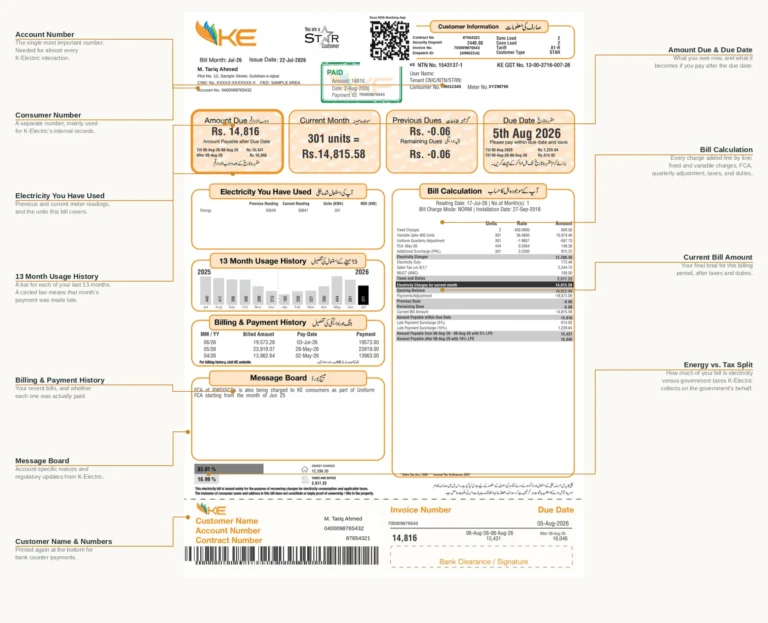
FCA in particular can add a noticeable amount to your bill and is not fixed in advance. Always check your actual bill for the current FCA figure rather than assuming a flat rate. If you’re confused about where to find these figures on your bill, visit our How to Read Your Bill guide.
3-Phase vs. Single-Phase: Does It Change Your K-Electric Unit Price?
For residential consumers, the energy rate is generally determined by the applicable tariff category and consumption slab. Whether the connection is single-phase or 3-phase is not itself the deciding factor. A 3-phase connection can support a higher sanctioned load, which may affect applicable fixed charges or tariff conditions. Check your bill for your tariff category and sanctioned load.
How to Reduce Your K-Electric Bill
- Stay at or below 200 units to keep your protected status and its lower rates.
- Shift heavy appliances like washing machines and water motors to off-peak hours if you are on a Time-of-Use tariff.
- Switch to inverter appliances, which use significantly fewer units for the same output.
- Use our KE bill calculator to estimate your full bill before committing to added usage. It includes fixed charges, FCA, and taxes.
- Check your KE duplicate bill each month to track which slab you are actually falling into.