
KE Load Shedding Schedule Today: Area-Wise Timings in Karachi
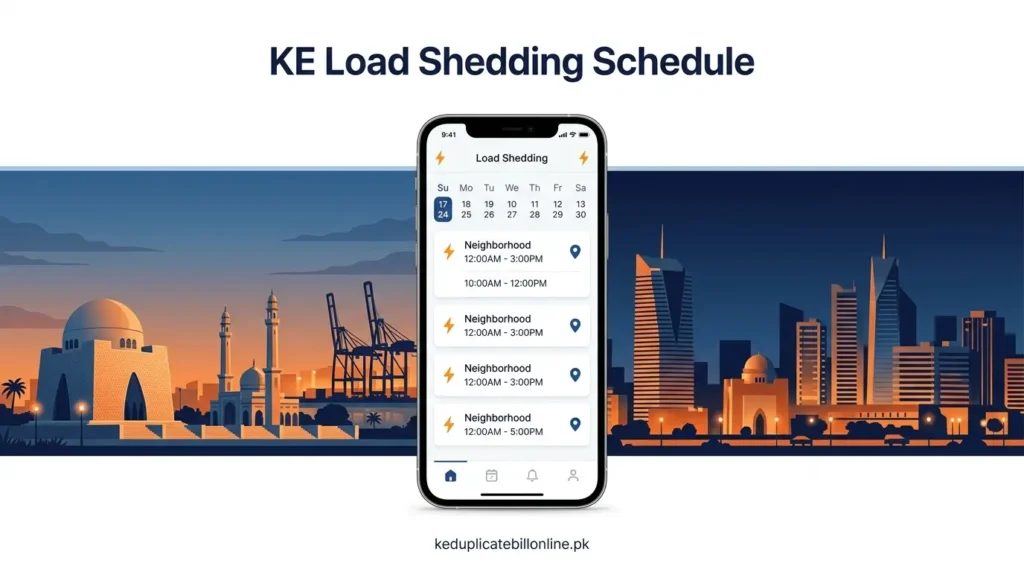
Your KE load shedding schedule depends on your feeder and area in Karachi. There is no single schedule for the entire city. Check your area’s current schedule through the KE Live app, SMS, the K-Electric website, or 118.
Load shedding is different from peak hours. Peak hours affect what you pay per unit. Load shedding affects whether you have power at all. See the peak hours section on our homepage for tariff timing.
Why Karachi’s Load Shedding Works Differently From the Rest of Pakistan
In April 2026, the federal government introduced a nationwide load shedding plan to manage fuel costs. K-Electric and HESCO were both exempted from it. The reason is regional. Karachi relies less on furnace oil for power generation than other parts of the country. The same cuts would not save the same fuel costs here.
This means Karachi’s load shedding is not driven by the national fuel-shortage schedule other cities follow. It runs on a separate system, based on individual feeder performance, explained below.
K-Electric’s own published schedules note that plant issues and fuel or gas supply problems can still cause contingency load shedding. Sudden demand spikes are another cause, beyond the regular rotation. Local supply issues can still affect any area from time to time, even in Karachi.
How K-Electric Decides Which Areas Face Load Shedding
K-Electric evaluates feeder performance using factors such as bill recovery and electricity losses. Recovery rate reflects how much of the billed electricity revenue is collected. Technical and commercial losses can include factors such as electricity theft.
| Factor | Effect on Load Shedding |
|---|---|
| Bill recovery rate | Higher recovery means less or no load shedding |
| Electricity theft (kundas) | Illegal connections increase a feeder’s loss rate |
| Infrastructure condition | Older cables and transformers add technical losses |
| Seasonal demand | Summer usage spikes can strain weaker feeders further |
Feeders with high recovery and low losses often see minimal or no scheduled load shedding. Feeders with low recovery and high losses face longer, more frequent cuts. This is a K-Electric-specific system tied to feeder performance, separate from the national plan described above.
Load Shedding Categories Across Karachi
K-Electric groups feeders into general loss categories, though your building’s exact feeder can differ from the wider neighborhood.
Checking the KE load shedding schedule today for your exact street matters more than relying on your area’s general reputation. Some Karachi areas and feeders may have little or no scheduled load shedding because of stronger recovery and lower losses. Exemption can vary by feeder and can change over time. Areas such as DHA, Clifton, Bath Island, Gulshan-e-Iqbal, Gulistan-e-Jauhar, and PECHS may have such feeders. This should not be treated as a guarantee for every street or feeder. Always check the current schedule for your specific connection.
Moderate-loss feeders typically see shorter, limited outages. High-loss feeders face longer, more frequent cuts. Because classification happens at the feeder level, two homes on the same street can have different schedules. Always confirm your specific feeder rather than relying on your neighborhood’s general reputation.
How to Check Your KE Load Shedding Schedule
| Method | How |
|---|---|
| KE Live App | Open the app, go to the Power tab, enter your details to see your feeder’s status |
| SMS | Send your area name to 8119 |
| Helpline | Call 118 and ask for your feeder’s schedule |
| Website | Visit ke.com.pk and check the published load shedding schedule |
| Message 0348-0000118 for account and outage-related queries |
K-Electric itself notes that published schedules can change with short notice, since feeder conditions are reviewed periodically. Treat any schedule, including this page, as a general guide and confirm through the app or helpline for same-day accuracy.
Scheduled vs. Unscheduled Load Shedding
Scheduled load shedding follows your feeder’s regular rotation based on its loss category. It is planned and repeats on a predictable pattern.
Unscheduled outages happen outside that rotation. Causes include equipment faults, storm damage, transformer issues, or the contingency factors mentioned earlier, like fuel or gas supply problems. Unscheduled outages need a repair crew rather than waiting out a rotation. Report one through the KE Live app, by calling 118, or through our K-Electric complaint guide if it goes unresolved.
K-Electric Maintenance Shutdowns
Maintenance shutdowns are different from both scheduled and unscheduled load shedding. K-Electric plans these in advance to upgrade cables, transformers, or grid equipment. Notice usually comes through the KE Live app, SMS, or the official website before the date. Unlike load shedding, a maintenance shutdown is not about recovery rate. It happens even in exempt, high-recovery areas when equipment genuinely needs work.
How to Reduce Load Shedding in Your Area
- Pay your K-Electric bill on time using our bill payment guide. Better bill recovery can contribute to improved feeder performance and classification.
- Report suspected electricity theft or illegal kunda connections to 118. This is confidential.
- Form or join a resident welfare group to formally request infrastructure upgrades from K-Electric.
- Reduce peak-hour consumption where possible to ease pressure on older feeders.
Areas that sustain higher recovery and lower losses over time can be reclassified by K-Electric into a lower loss category. That can reduce future load shedding hours.
Official sources for the information on this page:
- K-Electric official website: ke.com.pk
- K-Electric’s published feeder-wise load shedding schedule: ke.com.pk (Load Shedding Schedule section)
- Federal government’s April 2026 nationwide load shedding announcement, via the Power Division
- NEPRA, Pakistan’s electricity regulator: nepra.org.pk